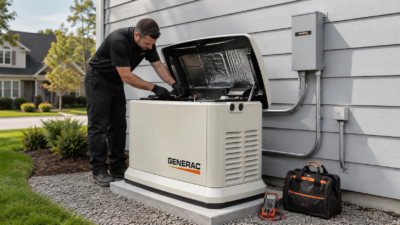
A practical Ontario homeowner’s guide to generator batteries, chargers, exercise cycles, and no-start problems
When homeowners think about their standby generator, they usually think about the engine, the size of the unit, the transfer switch, or the fuel supply. They think about whether the generator is a 14 kW, 18 kW, 22 kW, 24 kW, or 26 kW unit. They think about natural gas versus propane. They think about whether the generator can run the furnace, sump pump, fridge, freezer, well pump, internet, and air conditioner.
But there is one small part of the system that often gets ignored until the worst possible time.
The battery.
A home standby generator may be permanently installed outside your house, connected to natural gas or propane, and ready to transfer power automatically. But if the battery is weak, dead, disconnected, frozen, undercharged, or not being maintained properly, the generator may not start when the power goes out.
That is a frustrating situation because everything else may be in place. The generator may look clean. The fuel may be available. The transfer switch may be installed correctly. The home may have a good backup power system on paper. But when the outage happens, the first thing the generator needs to do is start. Without a healthy battery, that first step can fail.
This article explains why the battery is so important in a standby generator system, what warning signs homeowners should watch for, how the charger and exercise cycle help, and why annual maintenance matters for Ontario homes.
This is not meant to turn homeowners into generator technicians. It is meant to help you understand the system well enough to avoid the most preventable backup power failure: a generator that does not start because the battery was neglected.
The battery is what wakes the generator up
A standby generator is automatic, but automatic does not mean magic.
When utility power fails, the generator controller senses the outage. The system waits for a short delay, then sends the start command. At that moment, the battery provides the power needed to crank the engine.
If the battery is strong, the generator starts, stabilizes, and the automatic transfer switch brings the home onto generator power. After utility power returns, the transfer switch moves the home back to normal power and the generator shuts down after its cool-down period.
If the battery is weak, the generator may crank slowly, fail to start, show a fault code, or not respond the way it should.
That is why the battery is not just an accessory. It is part of the emergency system.
A standby generator can sit quietly for weeks or months. It may only run its weekly exercise cycle and then wait. But when a storm knocks out the power, the battery has to perform immediately. There is no warm-up period. There is no second chance if the home is empty. There is no homeowner standing beside it with a booster pack in the middle of the night.
The battery has to be ready before the outage.
Why generator batteries fail
Generator batteries fail for several reasons. Some are related to age. Some are related to charging. Some are related to weather. Some are related to lack of maintenance.
The first reason is simple aging. A battery is a wear item. Even if it is not used every day, it slowly loses capacity over time. A battery that was strong when installed can become weak after several years. It may still show some voltage, but not have enough cranking power under load.
The second reason is charging problems. Standby generators normally have a charging system that keeps the battery maintained while the generator is in standby mode. If the charger fails, loses power, has a wiring issue, or is not working correctly, the battery may slowly discharge. The homeowner may not notice until the generator tries to start and cannot.
The third reason is cold weather. Ontario winters are hard on batteries. Cold temperatures reduce battery performance and increase the effort needed to crank an engine. A battery that might start the generator in mild weather may struggle when it is freezing outside.
The fourth reason is long periods without proper testing. A generator can look fine from the outside while the battery is getting weaker inside. Unless the battery is tested, the homeowner may not know there is a problem.
The fifth reason is poor connections. Corrosion, loose terminals, damaged cables, or dirty connections can prevent the battery from delivering full power to the starter. Sometimes the battery itself is not the only issue. The connection between the battery and generator matters too.
The sixth reason is neglect after fault messages. Some homeowners see a warning light or message and leave it for later. With a generator, “later” can become a problem if an outage happens first.
A battery problem is usually small and manageable when caught early. It becomes a major problem when the power is already out.
“But my generator exercises every week. Doesn’t that mean it is fine?”
The weekly exercise cycle is useful, but it is not a full maintenance program.
Most standby generators are set to run automatically on a schedule. This exercise cycle helps keep the engine active, circulates oil, confirms that the unit can start, and gives the system a chance to detect certain problems.
But a weekly exercise cycle does not prove everything is perfect.
A generator may start during exercise on a mild day and still struggle during a real outage in cold weather. It may run without carrying the home’s load. It may start today but have a battery that is close to failing next month. It may have a charger issue that only becomes obvious after the battery has discharged further.
Exercise is important, but it does not replace service.
Think of it like starting a car once a week in the driveway. That tells you the car starts today, but it does not mean the oil is good, the battery is healthy under load, the filters are clean, or the vehicle is ready for a long winter drive.
A standby generator is the same way. The exercise cycle is a helpful check, not a complete inspection.
The battery charger is just as important as the battery
The battery and charger work together.
The battery provides starting power. The charger helps keep the battery ready while the generator is waiting in standby mode. If the charger is not working, the battery may lose charge over time. If the battery is old or damaged, the charger may not be able to save it.
This is one reason a technician checks more than just the battery during a maintenance visit. They may also check charging voltage, wiring, terminals, controller messages, and signs of charger failure.
A homeowner may replace a battery and still have problems if the real issue is the charger. On the other hand, a charger may be working properly, but the battery may be too old or weak to hold charge.
That is why diagnosis matters.
A proper service visit should not be just “throw a battery in it.” The technician should confirm what is actually happening. Is the battery weak? Is it not charging? Are the terminals loose? Is the charger working? Is the controller showing a warning? Is the generator losing utility sensing power? Is there another issue causing the battery to drain?
The battery system is small, but it can tell a lot about the generator’s readiness.
Warning signs of a weak standby generator battery
Homeowners should not ignore warning signs. Some signs are obvious. Others are subtle.
One warning sign is slow cranking. If the generator sounds like it is struggling to turn over during exercise or startup, the battery may be weak.
Another warning sign is a failed exercise cycle. If the generator does not complete its weekly exercise or shows an error afterward, it should be checked.
A third warning sign is a warning light or fault message on the controller. Depending on the generator model, the message may relate to battery voltage, charger warning, overcrank, or another starting issue.
A fourth warning sign is age. If the battery is several years old, it should be tested even if it seems fine. Batteries do not always fail slowly in a way homeowners notice.
A fifth warning sign is corrosion around the terminals. White, green, or crusty buildup near battery posts or cable ends can affect the connection.
A sixth warning sign is a generator that starts sometimes but not consistently. Intermittent starting problems should be treated seriously because they often get worse under stress.
A seventh warning sign is no sound at all during an outage or test. If the generator does not even attempt to crank, there may be a battery, control, wiring, or system issue that needs diagnosis.
If you notice any of these signs, it is better to schedule service before the next storm. Waiting until the outage happens is the most expensive way to find out something was wrong.
Why cold weather makes battery problems worse
Ontario homeowners should pay special attention to generator batteries before winter.
Cold weather affects batteries in two ways. First, it reduces the battery’s ability to deliver power. Second, it makes the engine harder to crank. Oil is thicker in cold conditions, mechanical resistance is higher, and the starter needs more effort.
That combination can expose a weak battery quickly.
A battery that was “okay” in September may fail during a January outage. This is why pre-winter service is valuable. The technician can inspect the generator, test the battery, check the charger, confirm the exercise cycle, inspect the air intake and exhaust area, and make sure the unit is not entering the worst season with preventable issues.
Winter also brings snow and ice. If snow blocks the generator, affects airflow, or makes service access difficult, problems can grow. A generator needs to be accessible and clear around intake and exhaust areas.
A battery is not the only winter concern, but it is one of the most common starting points for trouble.
Battery type and replacement should match the generator
Not every battery is right for every standby generator.
The correct battery size and rating depend on the generator model. Some air-cooled home standby generators require a specific group size and minimum cold cranking amps. The safest approach is to check the owner’s manual, model information, or have a qualified service provider confirm the proper replacement. Generac also provides product support and model-specific information through its owner-support resources.
Using the wrong battery can create problems. A battery that is physically the wrong size may not fit properly. A battery with insufficient cranking amps may struggle in cold weather. A poor-quality battery may fail sooner than expected.
For homeowners, the practical advice is simple: do not guess.
If you are replacing a standby generator battery, confirm the correct battery for your exact model. If you are not comfortable doing that, schedule service. A technician can replace it properly, inspect the connections, check charging, and reset or review any controller messages.
A battery replacement is not complicated for a trained technician, but it still has to be done correctly.
What happens during a professional battery check?
A professional battery check is more than looking at the battery and saying it seems okay.
A technician may inspect the battery age, terminals, cable condition, connection tightness, charger operation, controller status, and startup performance. They may test voltage and, where appropriate, perform a load test or recommend replacement based on age and performance.
They may also run the generator and listen to how it cranks. A trained ear can often tell when a generator is struggling. The sound of slow cranking, repeated crank attempts, clicking, or hesitation can point toward battery or starting system problems.
The technician may also check for related issues. For example, if the battery is low, why is it low? Is the charger functioning? Is the utility power to the charger present? Is there a blown fuse? Is there a wiring problem? Is the controller showing a charger warning? Is the battery simply old?
The goal is not only to get the generator running today. The goal is to make sure it is ready for the next outage.
Why annual generator maintenance should include battery testing
Annual maintenance should always include attention to the battery.
Many homeowners think generator maintenance is only oil and filters. Those are important, but they are not the whole story. A proper service visit should look at the system as emergency equipment.
Depending on the generator model and service schedule, maintenance may include oil, oil filter, air filter, spark plugs, general inspection, firmware or controller checks, cleaning, operation testing, and battery inspection. Generac notes that model-specific maintenance tasks and schedules are found in the owner’s manual, and Generac maintenance kits commonly include items such as oil filter, air filter, spark plugs, and oil depending on the kit and model.
The battery should be part of that discussion because the generator cannot protect the home if it cannot start.
A good technician will not only change parts. They will look at the condition of the equipment, listen to the startup, check for fault history, inspect the enclosure, look for rodent activity, check the battery, and make recommendations before the problem becomes urgent.
For Ontario homeowners, annual service is not just a nice extra. It is part of owning standby power responsibly.
Why a generator can fail even if it “looks new”
A standby generator can look clean from the outside and still have a weak battery.
This is one of the reasons homeowners get caught off guard. The enclosure may look good. The landscaping may be clean. The unit may not be very old. But the battery could still be weak, undercharged, or failing.
Batteries are not judged by appearance alone. A clean battery can fail a load test. A generator that has barely run can still have a battery problem. In fact, standby use can be hard on batteries because the battery spends most of its life waiting, not actively cycling like a vehicle battery.
This is also why “we never use it” is not a reason to skip service.
A generator that never runs during outages still exercises, sits outdoors, charges, monitors, and ages. The oil still ages. The battery still ages. The terminals can still corrode. Insects and rodents can still get inside. Moisture can still affect components.
Emergency equipment needs maintenance because it may sit unused for long periods and then be expected to work immediately.
What to do if your generator does not start during an outage
If your standby generator does not start during an outage, the first thing is safety.
Do not start opening electrical equipment or trying to bypass the system. Do not attempt unsafe repairs in bad weather, darkness, or wet conditions. If you are not trained, do not work inside the generator or transfer switch.
You can check simple things from a safe position. Look at the generator controller if it is safe to do so. See whether there is a visible warning message or light. Check whether the generator is blocked by snow or debris. Listen for whether it is trying to crank or completely silent.
If the generator is showing a fault, take a photo of the message if possible. That can help the service technician. If you have Mobile Link or remote monitoring, check the status in the app if available.
Then call for service.
A no-start problem can come from the battery, charger, fuel supply, controller, starter, wiring, low oil condition, blocked intake, or other causes. Guessing during an outage can waste time and create safety risks.
The best approach is prevention. If the battery is checked and the generator is maintained before storm season, the chance of an outage surprise is lower.
Can homeowners change the battery themselves?
Some homeowners are comfortable replacing a standby generator battery themselves. Others should not.
The answer depends on the homeowner’s skill level, the generator model, access, safety understanding, and whether they know the correct shutdown and restart procedure. A standby generator is connected to electrical equipment and is designed to start automatically. That means homeowners should not treat it casually.
If you do not know how to safely disable the generator before servicing the battery, do not attempt it. If you are not sure which battery is correct, do not guess. If there are active fault messages, charging warnings, damaged cables, corrosion, or signs of a larger issue, schedule professional service.
Even if the battery replacement itself is straightforward, a technician can also verify the charger, inspect terminals, review the controller, and test the generator afterward.
For many homeowners, that peace of mind is worth it.
How often should the battery be replaced?
There is no single answer that applies perfectly to every generator, battery, home, and climate condition.
Battery life depends on the battery quality, charger performance, temperature, maintenance history, generator model, usage, and environment. In Ontario, cold weather can be hard on batteries, so testing matters.
Instead of relying only on age, the best approach is to test the battery during regular maintenance and replace it before it becomes unreliable. If the battery is getting older, showing weak performance, failing a load test, or causing warning messages, replacement should be considered.
Waiting for the battery to fail completely is not a good strategy for emergency equipment.
A car battery often gives you warning because you drive the vehicle regularly. A generator battery may not give you the same daily reminder. It may sit quietly until the exact moment you need it.
That is why proactive replacement can make sense.
The role of remote monitoring
Many modern standby generators can be connected to monitoring tools that show operating status, maintenance reminders, and alerts. Generac’s support information notes that Mobile Link can connect homeowners to generator and propane tank information, including operating status and maintenance schedule access.
Remote monitoring can be useful because it helps homeowners notice problems sooner. If the generator has a fault, missed exercise, low battery warning, or maintenance reminder, the homeowner may be able to act before the next outage.
But remote monitoring does not replace maintenance.
It is a tool. It helps you see status information. It does not physically test the battery under load, clean terminals, change oil, inspect the air filter, or confirm fuel supply.
The best setup is remote monitoring plus regular service. Monitoring gives awareness. Maintenance gives reliability.
Battery problems are small until the power goes out
A weak battery is usually not a dramatic problem on a normal day. The lights are on. The furnace works. The fridge is running. The homeowner walks past the generator and everything looks fine.
Then a storm comes through. The utility power fails. The generator receives the start command. The battery cannot do its job. Suddenly, a small maintenance issue becomes a real outage problem.
That is why battery care is not about the battery itself. It is about protecting the purpose of the whole system.
The generator is there to protect your home from power loss. The battery is what allows it to begin that protection.
For homes with sump pumps, well pumps, medical equipment, home offices, freezers, security systems, or winter heating concerns, a no-start problem is more than an inconvenience. It can lead to damage, discomfort, and stress.
Preventing that starts with regular checks.
A simple homeowner checklist for generator battery readiness
Here is a simple checklist homeowners can follow:
Listen to the weekly exercise cycle. If it sounds slow or unusual, schedule service.
Look for warning lights or fault messages on the controller.
Keep the generator area clear of snow, leaves, and debris.
Make sure the generator lid and panels are accessible for service.
Ask for battery testing during annual maintenance.
Replace aging or weak batteries before storm season.
Do not ignore charger warnings.
Keep service records and battery replacement dates.
Use the correct battery for your generator model.
Call a professional if the generator fails to start, cranks slowly, or shows repeated faults.
This checklist does not replace professional service, but it helps homeowners stay aware.
Why this matters more for rural and cottage properties
Battery readiness is important for every standby generator, but it can matter even more for rural homes and cottages.
In rural areas, outages may last longer. Roads may be harder to access during storms. Service response may take more time during widespread outage events. If the home has a private well, no generator can mean no running water. If it has a sump pump, no generator can mean water damage. If it is a seasonal property, the homeowner may not be there when the outage happens.
For cottages, automatic standby power is often installed specifically because the owner wants protection when no one is there. But if the battery is neglected, that automatic protection may not happen.
A battery failure at a full-time home is frustrating. A battery failure at an unattended cottage can go unnoticed until damage is already done.
That makes preventive maintenance even more important.
Why this matters for homes with sump pumps
Many Ontario homeowners install standby generators because of sump pump concerns.
A sump pump does its most important work during wet weather, thawing snow, heavy rain, or high groundwater. Unfortunately, those are also conditions that can happen during storms and outages.
If the generator battery fails, the generator may not start. If the generator does not start, the sump pump may not run. If the sump pump does not run, the basement may be at risk.
That chain of events can happen quickly.
For homeowners with finished basements, stored valuables, mechanical rooms, or previous water issues, the generator battery is directly connected to water damage prevention. It is not just a small part under the lid. It is part of the protection plan for the home.
Why this matters for winter heating
A standby generator can help keep a home’s heating system operating during an outage, depending on how the system is configured.
Even if the home uses natural gas or propane heat, the furnace or boiler usually needs electricity for controls, ignition, fans, pumps, or circulation. If the power goes out and the generator does not start, the heat may not run.
In a short outage, that may only be uncomfortable. In a long winter outage, it can become serious. Pipes can freeze. The house can get dangerously cold. Older adults, children, pets, and anyone with health concerns may be affected more quickly.
That is why pre-winter maintenance should include the battery. A weak battery should be dealt with before freezing temperatures and storm season.
What a good service visit should feel like
A good generator service visit should feel thorough, not rushed.
The technician should treat the generator as a complete system. They should inspect, test, service, and explain what they found. If the battery is weak, they should explain the concern. If the charger is not working, they should explain the next step. If the generator has fault history, they should review it. If parts are due, they should recommend them.
Homeowners should feel comfortable asking questions:
How old is the battery?
Did it pass testing?
Is the charger working?
Were there any fault codes?
Did the generator start normally?
Is the exercise schedule set properly?
Are there any signs of corrosion or rodent damage?
Is the unit ready for winter?
Do I need a battery replacement soon?
These are normal questions. A good service provider should be able to answer them clearly.
Final thoughts: the generator is only ready if the battery is ready
A standby generator is one of the best investments a homeowner can make for backup power. It can protect your heat, sump pump, fridge, freezer, well pump, lights, internet, security system, and everyday comfort during an outage.
But the generator has to start.
That is why the battery deserves more attention than it usually gets. A weak battery can turn a complete backup power system into a silent box outside the house. The good news is that battery problems are often preventable with regular maintenance, testing, proper charging, and timely replacement.
At Generator Experts, we help Ontario homeowners install, maintain, and service Generac standby generator systems so they are ready when the next outage happens. Whether your generator is new, several years old, showing a warning message, missing its exercise cycle, or simply due for annual maintenance, our team can inspect the system and help keep it dependable.
If you are not sure when your generator battery was last tested, now is the right time to check. Book a generator maintenance or service visit with Generator Experts and make sure your backup power system is ready before the next storm.